

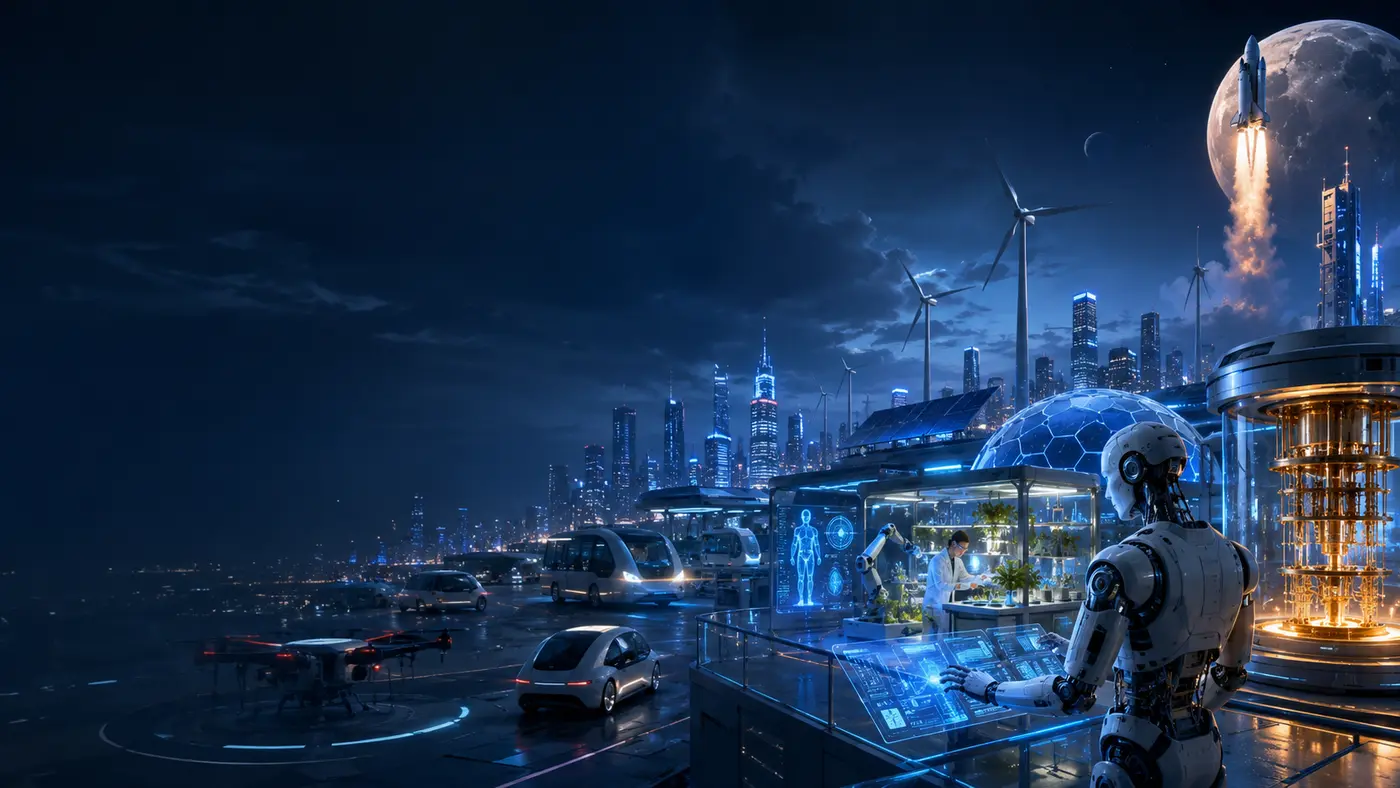
Technologies that appear experimental today may become practical tools by 2030. Artificial intelligence is already changing office work, robotics is moving beyond factories, renewable energy is expanding, and biotechnology is creating new approaches to medicine and agriculture.
However, predicting technology is uncertain. Regulation, cost, infrastructure, public trust, and scientific breakthroughs will determine which innovations scale. This guide examines 10 future technologies for 2030, separating credible developments from claims that remain speculative.
What Is Future Technology?
Future technology includes systems and inventions that are under active development and may significantly change industries or daily life. Some are already commercially available but not yet widely adopted; others remain in laboratories or limited trials.
A technology belongs on this list when it:
- Is supported by active research or real-world investment
- Could solve an important economic or social problem
- May transform several industries
- Has a plausible path toward wider use by 2030
10 Future Technologies to Watch: Quick Comparison
| Technology | Likely impact by 2030 | Current maturity |
|---|---|---|
| Artificial intelligence | Automation, analysis, and personalized services | Already deployed and expanding |
| Quantum computing | Specialized scientific calculations | Experimental |
| Robotics | Manufacturing, logistics, healthcare, and field work | Commercial but uneven |
| Brain–computer interfaces | Assistive medical communication and control | Early clinical development |
| Biotechnology | New therapies, diagnostics, and resilient crops | Mixed: commercial and experimental |
| Clean energy | More solar, wind, batteries, and electrification | Rapid commercial growth |
| Autonomous transport | Limited driverless services and automated logistics | Commercial in selected locations |
| Smart cities and IoT | Connected infrastructure and resource management | Already deployed selectively |
| AR and VR | Training, design, entertainment, and collaboration | Commercial but not universal |
| Space technology | Reusable launches, lunar missions, and satellite services | Rapid development |
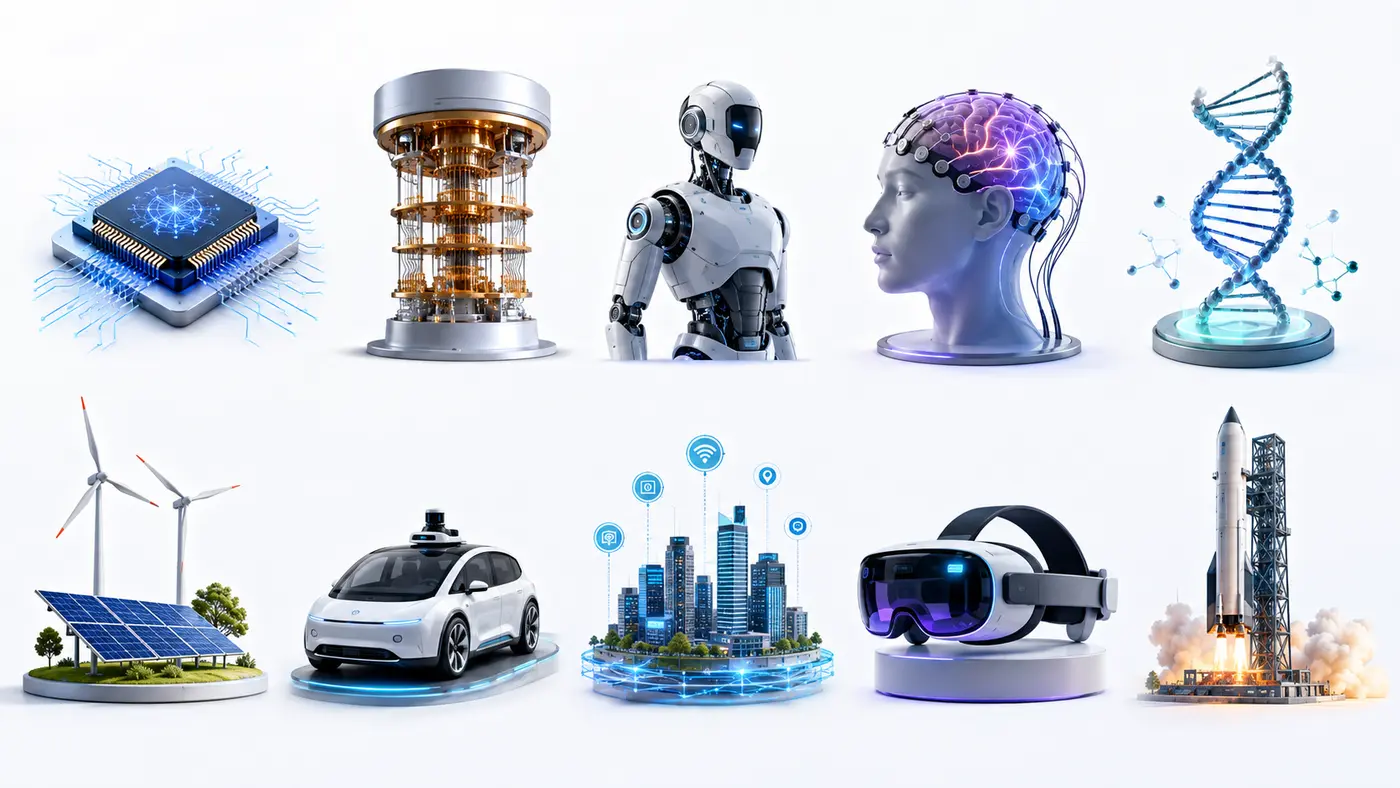
Ten technology fields likely to influence industry and society through 2030.
1. Artificial Intelligence Becomes Embedded Everywhere
AI is moving from standalone chatbots into software, devices, vehicles, laboratories, and business workflows. By 2030, more organizations are likely to use AI agents for research, customer service, coding, analysis, scheduling, and administrative support.
Healthcare professionals may use AI to assist diagnosis and medical imaging; teachers may use adaptive learning tools; creators may use generative media; and manufacturers may combine AI with robots. These systems will still require human oversight, data protection, testing, and accountability.
The World Economic Forum’s Future of Jobs Report identifies AI and information processing as major forces expected to transform business by 2030. This does not mean AI will automate every job or replace 80% of office work.
2. Quantum Computing Targets Specialized Problems
Quantum computers use quantum effects to approach certain calculations differently from conventional computers. They are not simply thousands of times faster at every task, and they are unlikely to replace laptops or ordinary data centers by 2030.
Their strongest potential lies in specialized problems involving quantum systems, chemistry, materials, optimization, and scientific simulation. The U.S. Department of Energy highlights molecular and physical-system calculations as promising applications.
Progress will depend on reducing errors, scaling reliable hardware, developing useful algorithms, and demonstrating advantages over classical systems.
3. Robotics Expands Beyond Traditional Factories
Industrial robots have worked in controlled factories for decades. The next stage involves more flexible machines operating in warehouses, hospitals, farms, construction sites, shops, and homes.
By 2030, robots may perform more inspection, material handling, delivery, cleaning, harvesting, and dangerous physical work. General-purpose home robots capable of reliably cooking and completing every household task are less certain.
Robotics can improve safety and productivity, but deployment depends on cost, reliability, maintenance, regulation, and whether a task is predictable enough to automate.
4. Brain–Computer Interfaces Focus on Medical Assistance
Brain–computer interfaces interpret neural signals so a user can communicate with or control a device. Researchers and companies are testing implanted and non-invasive systems for people with paralysis, speech loss, and other neurological conditions.
By 2030, BCIs may provide better assistive communication and device control for selected patients. Claims about broadly enhancing memory, enabling silent communication for everyone, or curing depression remain much less certain.
Safety, long-term reliability, informed consent, security, affordability, and ownership of neural data will be central concerns.
5. Biotechnology and Gene Editing Advance Medicine
Gene editing, synthetic biology, advanced diagnostics, and personalized medicine are changing how researchers understand and treat disease. CRISPR-based treatments have moved from theory into regulated medicine for specific conditions, while many other applications remain in trials.
By 2030, biotechnology could support more targeted therapies, faster drug discovery, engineered tissues, disease-resistant crops, and improved diagnostics. It will not eliminate all genetic disease or reliably stop human aging within a few years.
Ethical oversight matters because changes to human genes, ecosystems, and food systems can create consequences that extend beyond an individual patient.
6. Clean Energy and Storage Scale Rapidly
Solar, wind, batteries, grid technology, heat pumps, electric transport, hydrogen, and carbon management are attracting major investment. Of all the technologies in this guide, renewable power has one of the clearest paths to large-scale expansion before 2030.
The International Energy Agency projects substantial renewable capacity growth through 2030, led heavily by solar power. Fossil fuels will not disappear globally by 2030, and commercial fusion power is not guaranteed on that timeline.
Electric grids, storage, financing, permitting, and supply chains will determine how quickly clean energy can expand.
7. Autonomous Transportation Grows Unevenly
Driver-assistance systems are common, while fully driverless services operate only in selected locations and conditions. By 2030, autonomous taxis, delivery robots, trucks, drones, and port or warehouse vehicles may be more visible.
Universal self-driving in every major city is not assured. Weather, road quality, unusual situations, insurance, mapping, cybersecurity, and local regulation make transportation automation difficult.
The largest early gains may appear in controlled routes and logistics rather than unrestricted personal driving everywhere.
8. Smart Cities and the Internet of Things
Connected sensors can help cities monitor traffic, electricity, water, air quality, infrastructure, and waste. Smart buildings can reduce energy use, while connected transport systems can improve scheduling and congestion management.
These systems can make public services more responsive, but they also create privacy and cybersecurity risks. Citywide surveillance should not automatically be treated as a public benefit.
Successful smart-city projects require clear governance, strong security, public transparency, and alternatives for people who cannot or do not want to use connected services.
9. Augmented and Virtual Reality Find Practical Niches
AR overlays digital information on the physical world, while VR creates a simulated environment. By 2030, these technologies may become more useful in training, product design, remote assistance, education, gaming, healthcare, and shopping.
Headsets may become lighter and more capable, but a single universal “metaverse” replacing the internet is far from guaranteed. Cost, comfort, privacy, social acceptance, and compelling applications will determine adoption.
10. Space Technology Builds a Larger Lunar Economy
Reusable rockets have reduced some launch costs, while commercial companies and national agencies are expanding satellite networks and lunar missions. NASA’s Artemis program is developing systems for sustained exploration of the Moon and future missions deeper into space.
By 2030, more lunar landings, scientific infrastructure, satellite services, and limited commercial space travel are plausible. A self-sufficient Mars settlement or mature asteroid-mining industry is not a realistic certainty for this period.
Other Emerging Technologies to Watch
- Digital twins for factories, buildings, and infrastructure
- Synthetic biology and biomanufacturing
- Advanced materials and nanotechnology
- Neuromorphic and biological computing
- 3D and 4D printing
- Holographic and spatial communication
How Technology Could Change Daily Life by 2030
At Home
AI assistants and connected appliances may help manage energy, security, schedules, shopping, and maintenance. Reliable multi-purpose household robots may remain expensive or limited.
At Work
AI agents will likely handle more drafting, analysis, support, and routine administration. People will still be needed for judgment, accountability, relationships, physical work, and complex decisions.
In Healthcare
AI-assisted screening, remote monitoring, personalized treatments, and some gene-based therapies may expand, subject to clinical evidence and regulatory approval.
In Education
AI tutors, adaptive lessons, translation, accessibility tools, simulations, and virtual laboratories may offer more personalized support. Teachers will remain essential for guidance, motivation, assessment, and safeguarding.
Jobs and Skills for the Future
Technology will create, change, and displace jobs rather than producing a simple replacement of old roles with an equal number of new ones. The World Economic Forum estimates major labor-market disruption through 2030, alongside a net increase in jobs in its employer survey. Outcomes will differ by country and industry.
Growing roles may include:
- AI and data specialists
- Robot technicians and automation engineers
- Cybersecurity professionals
- Renewable-energy technicians
- Biotechnology and laboratory specialists
- Autonomous-system safety operators
- Data governance and AI ethics professionals
- Extended-reality designers
Adaptability, analytical thinking, digital literacy, communication, cybersecurity awareness, and continuous learning are likely to matter across many occupations.
Risks and Challenges
- Job displacement: Some routine roles may shrink before workers can move into new opportunities.
- Privacy: Connected devices, AI, and BCIs can collect highly sensitive data.
- Cybersecurity: More connected infrastructure creates more targets for attack.
- Bias and accountability: Automated decisions can reproduce unfair patterns or hide responsibility.
- Inequality: Benefits may concentrate in wealthy companies, workers, or countries.
- Environmental cost: Data centers, batteries, hardware production, and mining consume energy and materials.
Frequently Asked Questions
What technology will have the biggest impact by 2030?
AI is likely to affect the widest range of industries, while clean energy, robotics, biotechnology, and connected infrastructure may have equally important effects in specific sectors.
Will robots replace most jobs by 2030?
No reliable evidence shows that robots will replace most jobs worldwide by 2030. Automation will change tasks and displace some roles while creating demand elsewhere.
Will quantum computers replace normal computers?
No. Quantum computers are being developed for specialized problems and are expected to work alongside classical systems rather than replace ordinary computers.
Will humans live on Mars by 2030?
A crewed Mars settlement by 2030 is highly uncertain. Near-term space development is more focused on lunar missions, orbital infrastructure, satellites, and technology testing.
Final Thoughts
The technologies most likely to shape 2030 are not all at the same stage. AI, renewable energy, and connected systems are already scaling. Robotics, biotechnology, autonomous transport, and extended reality are developing unevenly. Quantum computing, BCIs, and permanent off-Earth settlements remain more experimental.
Understanding both the opportunity and uncertainty is more useful than assuming every prediction will happen on schedule. People, businesses, and governments that build adaptable skills and responsible policies will be better prepared for whichever technologies mature first.