



Disclosure: This article is for informational purposes. Product availability, eligibility, and technical details may change as OpenAI moves the service from preview toward a broader rollout.
For companies adopting powerful AI models, the biggest question is no longer simply, “How capable is the model?” The harder question is, “Can we use it without losing control of sensitive information?”
That concern becomes especially serious in healthcare, finance, legal services, research, government, and any business that handles confidential customer records. These organizations want AI systems that can reason across longer tasks and perform useful work, but they cannot casually allow prompts, responses, internal documents, or proprietary data to remain visible to a technology provider.
On August 19, 2026, OpenAI announced a preview of Private Safety Processing, an approach designed to strengthen safeguards for advanced AI systems while remaining compatible with Zero Data Retention, commonly shortened to ZDR. The announcement matters because it tackles a real tension in enterprise AI: a provider needs enough context to detect dangerous patterns, while customers need strong privacy and control over their information.
Private Safety Processing is OpenAI’s proposed way of addressing both needs. It is not a promise that every privacy or security problem has been solved. It is also not a feature that every ChatGPT user can switch on today. OpenAI says the system is being tested with early customers, with a rollout and technical white paper planned for September.
Here is what the announcement means, how the system is supposed to work, who may benefit, and what businesses should verify before relying on it.
What Did OpenAI Announce?
OpenAI announced that it is previewing Private Safety Processing for eligible customers using frontier models under Zero Data Retention arrangements.
Under ZDR, eligible API customers receive a clear data-handling commitment: OpenAI does not retain their prompts or model responses after processing. OpenAI also says enterprise customer data is not used to train its models unless the customer explicitly chooses to opt in.
That arrangement is valuable for privacy, but it creates a difficult safety problem. A harmful request may be easy to detect when viewed alone. More sophisticated misuse, however, can be spread across many interactions. A person may ask a sequence of innocent-looking questions that only becomes dangerous when the requests are connected. An AI agent may also begin a legitimate task and then behave in a way that no longer matches the user’s instructions.
Traditional ZDR-compatible controls generally examine an interaction individually. Private Safety Processing is intended to let automated safeguards identify patterns across related interactions without allowing OpenAI personnel to read the underlying prompts and responses.
According to the official OpenAI announcement, the provider receives a narrowly defined safety signal when a risk is identified. The signal indicates the category of concerning activity rather than exposing the customer’s complete content. OpenAI can then decide whether enforcement is necessary.
The distinction is important. The system is meant to produce a limited warning about a potential risk, not deliver a readable transcript to a human reviewer.
What Is Zero Data Retention?
Zero Data Retention is a data-control option available to eligible OpenAI API customers. In simple terms, it means customer prompts and model outputs are not retained by OpenAI after a request has been processed, subject to the applicable terms, endpoint limitations, and legal exceptions.
ZDR is different from merely promising not to use customer data for model training. A provider could decide not to train on information while still retaining it for logging, abuse monitoring, debugging, or other operational purposes. Zero Data Retention goes further by limiting retention itself for eligible use cases.
The exact treatment of data can depend on the OpenAI product, endpoint, feature, and account configuration. A company should therefore review the current OpenAI API data-control documentation instead of assuming that every API feature automatically follows the same retention policy.
Businesses should also distinguish between the API, ChatGPT Business, ChatGPT Enterprise, and consumer ChatGPT accounts. These products do not necessarily have identical controls. OpenAI’s enterprise privacy page explains its broader commitments for business products, but a technical team still needs to confirm the rules for its specific deployment.
Why Existing AI Safety Monitoring Has a Blind Spot
Imagine that a security system receives one request: “Explain how authentication tokens work.” That question can be completely legitimate. A student, developer, or security professional may ask it for educational reasons.
Now imagine hundreds of related requests distributed across multiple sessions. The user repeatedly asks how to bypass safeguards, tests different phrasings, requests pieces of exploit code, and gradually assembles them into a working attack. Each prompt may appear less alarming when separated from the others. Together, they reveal a pattern.
This is the blind spot OpenAI says it wants Private Safety Processing to address.
The same problem appears in agentic workflows. AI agents can perform multi-step tasks, use tools, access approved information, and continue working for longer periods. That creates more value, but it also increases the number of decisions the system makes. A risk may emerge over time rather than in one obvious response.
For example, an agent could be asked to organize company files. If it later attempts to access an unapproved folder, continues after the user tells it to stop, or tries to send data outside the intended system, the concern comes from the sequence of actions. A single isolated event may not tell the whole story.
Safety monitoring therefore benefits from context. Privacy requirements, however, often discourage retaining that context. Private Safety Processing is an effort to let automated systems use broader context while keeping the underlying content inaccessible to OpenAI personnel.
How Private Safety Processing Is Supposed to Work
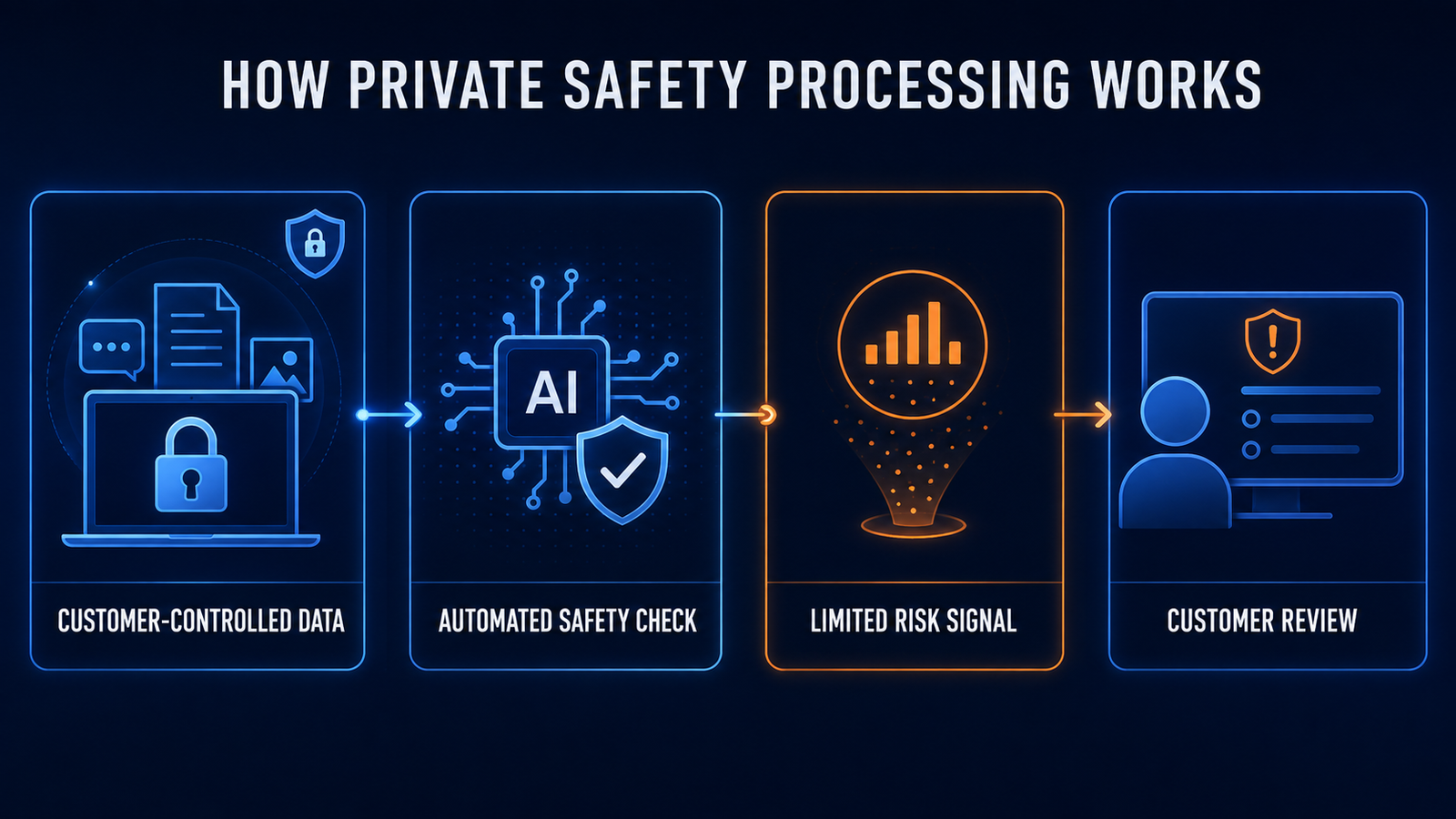
OpenAI has described the high-level design, but it has not yet published the promised full technical white paper. Based on the announcement, the process has four main parts.
1. Customer Content Remains Under Customer Control
In a ZDR deployment, the content remains on infrastructure controlled by the customer. OpenAI is also developing an alternative in which content can be stored on OpenAI infrastructure but encrypted using keys controlled by the customer.
The second option matters because encryption is only as protective as its key management. OpenAI says its personnel would not hold copies of the customer-controlled keys and therefore could not decrypt the underlying information.
This should not be interpreted as a reason to skip normal security work. Customers would still need strong access controls, key rotation, incident response, network protection, and appropriate employee permissions.
2. Automated Systems Examine Related Activity
Instead of checking only one interaction at a time, automated safeguards can evaluate related activity for patterns that may suggest misuse or misalignment.
The announcement does not yet provide enough technical detail to independently assess every aspect of this process. Important unanswered questions include how interactions are linked, how long relevant state is evaluated, how false positives are reduced, and what information is used to classify a pattern.
These are areas businesses should examine when OpenAI publishes the technical white paper.
3. OpenAI Receives a Limited Safety Signal
When the automated system identifies a risk, OpenAI says it receives a narrowly defined signal describing the type of activity involved. Personnel do not receive the customer’s underlying prompts or responses, even when the activity is flagged.
That limited signal can inform an enforcement decision. Depending on the final implementation and applicable policies, enforcement could potentially involve blocking an action, restricting a capability, or investigating account-level misuse. OpenAI has not presented every operational detail in the initial announcement.
4. Customers Can Investigate Using Their Own Records
Customers retain information in their own systems and can use it to investigate an alert or enforcement decision. If the activity was legitimate, they may choose to share relevant evidence with OpenAI for an appeal or clarification.
The word “choose” is central here. The customer decides whether to disclose the supporting content. The design is intended to prevent the safety system from automatically giving OpenAI personnel access to confidential information.
What Private Safety Processing Does Not Mean
New AI announcements are often summarized too aggressively. Private Safety Processing should not be described as “perfect privacy,” “unbreakable security,” or a complete replacement for enterprise governance.
It does not mean:
- Every OpenAI customer automatically receives Zero Data Retention.
- Every API endpoint or feature has identical data controls.
- No information of any kind is ever processed for safety.
- An encrypted system cannot be misconfigured by a customer.
- Automated safety classifiers will never make mistakes.
- Businesses can upload sensitive data without completing a risk assessment.
- Human oversight, access control, auditing, and incident response are no longer necessary.
OpenAI also notes a legal exception involving apparent child sexual abuse material. Images flagged as potential CSAM continue to be retained for required manual review and reporting, including in ZDR deployments. This exception should be stated clearly because “zero retention” should not be presented as an absolute promise without context.
Why This Matters for Enterprise AI Adoption
Privacy has become one of the main obstacles preventing organizations from moving AI projects from experiments into production.
A small team can test a chatbot with public information without creating much risk. The situation changes when the company wants the system to read contracts, summarize medical records, analyze financial transactions, review proprietary code, or assist with confidential research.
At that point, three groups begin asking difficult questions:
- Security teams want to know where the data goes and who can access it.
- Legal and compliance teams want to know whether the deployment satisfies contracts and regulations.
- Business leaders want useful AI without exposing customer trust or competitive information.
Private Safety Processing is relevant because it tries to prevent privacy and safety from becoming an either-or choice. If the design performs as described, organizations may be able to use stronger contextual safeguards without allowing a provider’s staff to inspect their content.
For readers exploring the wider business impact of artificial intelligence, our guide to the best AI tools for small businesses explains how companies can choose practical tools without adopting every new product at once.
Industries That Could Benefit Most
Healthcare
Healthcare organizations handle clinical notes, patient identifiers, diagnostic records, and other highly sensitive information. AI can help summarize documents, support administrative work, and assist research, but the privacy threshold is high.
A system that combines customer-controlled data with cross-interaction safety monitoring may be useful. However, healthcare providers would still need to verify regulatory requirements, contracts, data residency, audit controls, and whether a specific deployment is appropriate for protected health information.
Financial Services
Banks, insurers, investment firms, and payment providers deal with financial records, fraud investigations, identity information, and confidential strategies. They also face sophisticated misuse risks.
Contextual safety signals could help detect suspicious patterns without exposing complete records to provider personnel. Yet financial institutions should demand detailed documentation about alert handling, encryption, key ownership, access logs, and operational resilience.
Legal Services
Law firms and legal departments cannot treat client confidentiality casually. AI may assist with document review, research preparation, and contract analysis, but accidental disclosure can create serious professional and legal consequences.
ZDR may reduce part of that exposure. Private Safety Processing could add broader safeguards, but neither feature removes the need for internal rules about which documents employees may upload and how AI-generated work is reviewed.
Software and Cybersecurity
Developers increasingly use AI to review proprietary code, investigate vulnerabilities, and automate technical workflows. The same capabilities can be misused for attacks.
This is an area where the tension between privacy and monitoring is especially visible. A legitimate security team needs confidentiality while analyzing its own systems. At the same time, providers need controls that discourage malicious use of capable models.
Research and Development
Companies and universities may work with unpublished findings, experimental data, product plans, and intellectual property. They want AI assistance without giving away the information that creates their competitive advantage.
Customer-controlled keys and ZDR can be attractive in such cases. Still, researchers must classify their data carefully and avoid assuming that a new preview is automatically approved for every sensitive project.
Questions Businesses Should Ask Before Adoption
The announcement is promising, but a professional procurement decision requires more than a press release. Before adopting Private Safety Processing, an organization should ask:
- Are we eligible for ZDR? Eligibility and supported features must be confirmed with OpenAI.
- Which endpoints are covered? Data controls may differ across APIs, tools, and storage features.
- Where does our content reside? Determine whether the deployment uses customer infrastructure or OpenAI-hosted encrypted storage.
- Who controls the encryption keys? Document key generation, storage, rotation, recovery, and revocation.
- What safety signals can OpenAI receive? Ask for precise definitions and examples.
- How are related interactions connected? Understand the identifiers, time windows, and boundaries involved.
- What happens after a signal is generated? Clarify blocking, enforcement, notification, and appeal procedures.
- How are false positives handled? Legitimate research and security work can resemble suspicious activity.
- What evidence will auditors receive? Compliance teams need documentation, logs, and contractual commitments.
- What is the fallback plan? A business should know how operations continue if the service changes, becomes unavailable, or produces unexpected results.
These questions are not signs of distrust. They are normal parts of responsible enterprise technology adoption.
A Practical Adoption Checklist
Businesses interested in the preview should avoid beginning with their most sensitive workflow. A controlled process is safer.
Step 1: Classify the Data
Separate public, internal, confidential, regulated, and highly restricted information. Do not treat all company data as one category.
Step 2: Choose a Narrow Use Case
Start with a task that provides measurable value but has manageable consequences if something goes wrong. A limited internal document workflow may be more suitable than an autonomous system with broad permissions.
Step 3: Confirm Contractual Controls
Review the applicable agreement, data-processing terms, retention commitments, and support procedures. Marketing language is not a substitute for a contract.
Step 4: Restrict Permissions
Give an AI agent only the tools and data needed for the approved task. Avoid broad access to entire drives, databases, email accounts, or production systems.
Step 5: Test Normal and Abnormal Behavior
Evaluate ordinary requests, ambiguous instructions, attempts to exceed authority, and stop commands. The team should know how the system behaves when the workflow changes unexpectedly.
Step 6: Monitor the Deployment
Track performance, errors, alerts, user behavior, and business outcomes. Privacy controls do not eliminate the need for observability.
Step 7: Review Regularly
Models, policies, and product settings change. A risk assessment completed once should not be treated as permanently valid.
Our overview of future technologies shaping the world by 2030 provides additional context on why AI governance will become more important as autonomous systems enter everyday business operations.
The Larger Trend: Privacy-Preserving AI
Private Safety Processing reflects a wider shift in enterprise AI. Companies increasingly want systems that can perform advanced reasoning without forcing them to surrender control over confidential information.
That demand is pushing providers toward customer-managed encryption, private networking, regional processing, stronger access controls, confidential computing, local deployment options, and clearer retention policies.
The competition will not be based only on model intelligence. For many organizations, the winning platform will be the one that combines capability with predictable governance.
This also changes how buyers should compare AI products. A benchmark score can show how well a model performs on a test, but it says little about whether the product fits a company’s legal, privacy, security, and operational requirements.
The practical question is not “Which AI model is smartest?” It is “Which complete system can perform our approved task while keeping risk within acceptable limits?”
Limitations and Open Questions
OpenAI’s announcement provides a useful overview, but the technical white paper has not yet been published. That means several details remain uncertain.
Independent observers still need information about the system’s architecture, threat model, accuracy, failure modes, auditability, and resistance to manipulation. Customers will also want to understand whether the safety signal itself could reveal sensitive metadata when combined with other account information.
Another concern is customer responsibility. If content stays in infrastructure controlled by the customer, the customer must secure that infrastructure correctly. Poor permissions, exposed keys, weak internal controls, or compromised administrator accounts could undermine the privacy benefits.
There is also the challenge of legitimate high-risk work. Cybersecurity teams, medical researchers, and other specialists may conduct activities that resemble misuse. A mature system needs a fair process for recognizing authorized work and resolving false positives.
For these reasons, the preview should be evaluated as a developing control—not treated as a finished universal solution.
Frequently Asked Questions
Is Private Safety Processing available to everyone?
No. OpenAI says it is currently being tested with early customers. The company plans to begin rolling it out and publish a technical white paper in September.
Does OpenAI read prompts flagged by the system?
OpenAI says its personnel do not receive access to the underlying customer content. The company receives a narrowly defined signal about the type of concerning activity.
Is Zero Data Retention the default for every OpenAI API customer?
No. ZDR applies to eligible customers and supported configurations. Businesses should verify their eligibility and the current rules for each endpoint they use.
Is enterprise data used to train OpenAI models?
OpenAI states that enterprise customer data is not used for model training unless the customer explicitly opts in. Organizations should still review the terms applying to their specific product and account.
Does ZDR mean no data can ever be retained under any circumstance?
No. OpenAI identifies a legal exception for images flagged as potential CSAM, which may be retained for required manual review and reporting.
Can Private Safety Processing replace a company’s security team?
No. It is a provider-side safeguard. Businesses still need data classification, access control, encryption management, monitoring, employee training, incident response, and compliance review.
Final Thoughts
OpenAI’s Private Safety Processing preview addresses one of the hardest problems in enterprise AI: how to recognize dangerous patterns across longer interactions without giving provider personnel access to confidential customer content.
The proposed design combines Zero Data Retention, customer-controlled infrastructure or encryption keys, automated cross-interaction analysis, and limited safety signals. If it works as described, it could make advanced AI more practical for organizations that previously considered the privacy trade-off unacceptable.
However, this is still an early preview. The technical white paper, wider rollout, real-world performance, and independent evaluation will matter more than the announcement alone. Businesses should not rush sensitive data into a new system simply because the words “zero retention” appear in its description.
The sensible approach is to verify eligibility, understand the architecture, start with a narrow use case, restrict permissions, test thoroughly, and keep human oversight in place.
Privacy and safety do not have to be opposing goals. But achieving both requires careful engineering, clear contracts, realistic expectations, and responsible use from the provider and the customer.